Brand activism peaked in 2020. The murder of George Floyd triggered a wave of corporate statements, DEI pledges, and social media commitments that had no precedent in scale or speed. For a brief moment, it looked like something had shifted permanently in how brands understood their relationship to society. It had not. What had shifted was the perceived cost of silence. And the moment that cost changed, most of the commitments went with it.
What we are left with, in 2026, is not a lesson about whether brands should take political positions. It is a much more specific lesson: about the difference between activism as identity and activism as positioning, and why that distinction has become commercially consequential in ways the industry is still struggling to absorb.
What brand activism actually means
The term was formalised by Sarkar and Kotler in Brand Activism: From Purpose to Action (2018), where they defined it as "business efforts to promote, impede, or direct social, political, economic and/or environmental reform with the desire to improve society" (Sarkar & Kotler, 2018). The critical distinction they draw is between brand activism and CSR: CSR is a corporate-driven commitment to improve ethical practices within a company's core operations; activism is linked to a brand's identity and addresses broader societal issues that often extend beyond the company's primary business activities (Cammarota et al., International Journal of Consumer Studies, 2023).
That distinction matters more now than when it was written. CSR is relatively easy to operationalise and relatively easy to verify. Brand activism, by contrast, makes an identity claim. It says: this is who we are, not just what we do. And identity claims, unlike operational commitments, cannot be quietly walked back when the political environment shifts. Audiences notice. And they remember.
I wrote about this dynamic in my MSc research on brand activism and positioning, conducted between 2019 and 2021, before the 2023 crisis made it impossible to ignore. The central question then was whether brands could function as genuine social agents, and what conditions would make that positioning credible rather than purely performative (Brands as social agents, Zirrah). The period that followed turned that research question into a series of very expensive case studies.
The period that changed everything
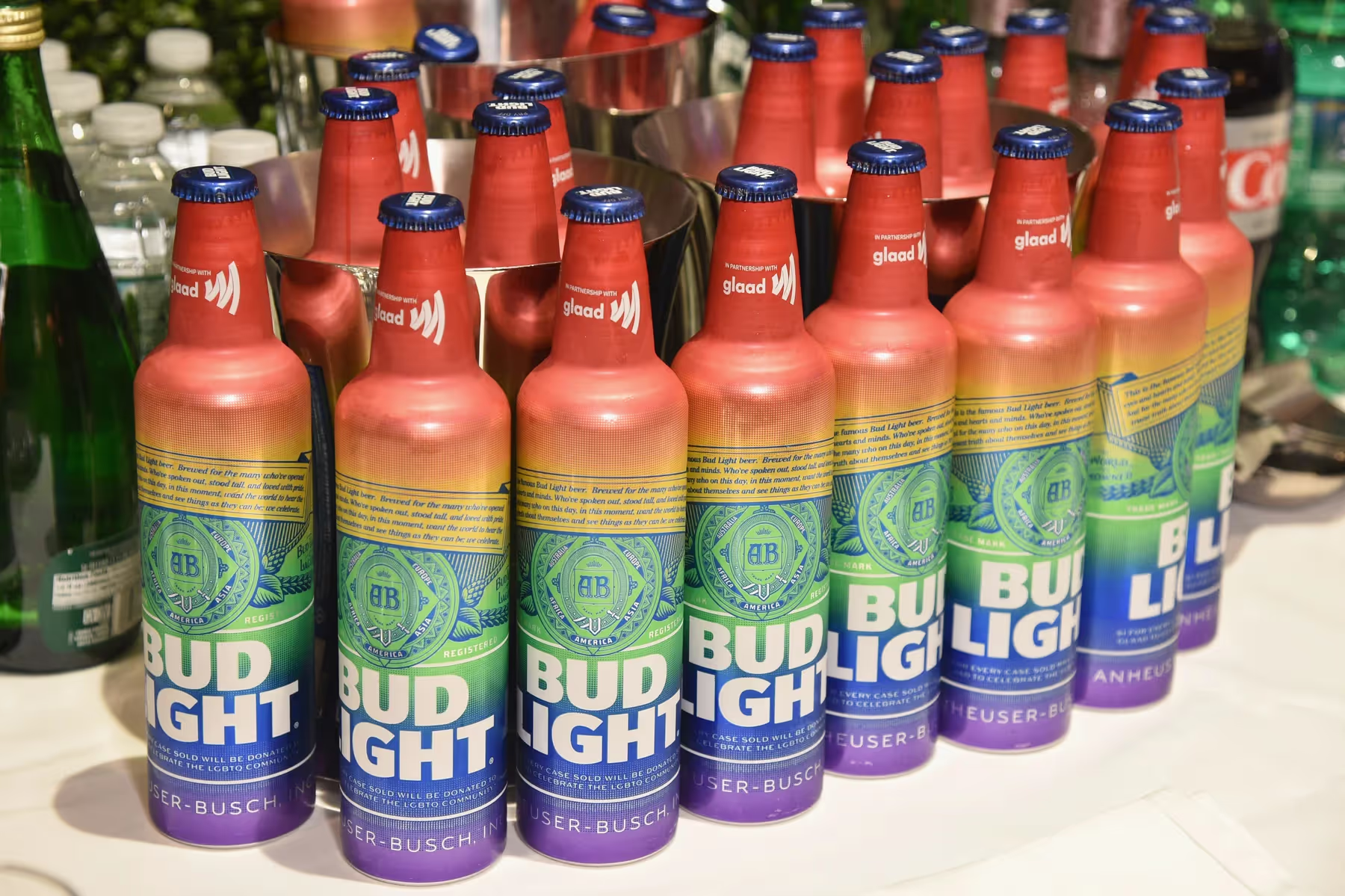
The 2023 Bud Light crisis is the most cited data point in this conversation, and for good reason. A single promotional collaboration with transgender influencer Dylan Mulvaney triggered a right-wing boycott that cost Anheuser-Busch InBev $1.4 billion in sales and ended Bud Light's decade-long run as America's best-selling beer (The Drum, 2025). The brand's fatal error was not the partnership. It was the response: two weeks of silence followed by a CEO statement that addressed product quality and patriotism without taking any position on the actual issue. The brand had made an identity-adjacent gesture without the identity to back it up. When challenged, there was nothing underneath.
Target followed a similar arc. After its 2023 Pride collection generated conservative backlash, including threats to employees, the brand pulled products and reduced visibility. In early 2025, it went further, ending its REACH racial equity strategy, withdrawing from the Human Rights Campaign's Corporate Equality Index, and rebranding its Supplier Diversity programme. The consequences were measurable and direct: Target's stock dropped 12%, store traffic fell 7.9% year-over-year in Q1 2025, and the company faced a shareholder class action lawsuit alleging it had misled investors by failing to disclose the risks of its DEI rollback (Diversity.com, 2025). The Twin Cities Pride Festival cancelled a $50,000 partnership. A 40-day consumer boycott was organised by civil rights groups.
The data across this period is consistent. Only 5% of consumers say they would increase their purchases in response to a brand rolling back DEI commitments. Meanwhile, 17% say they would openly stop purchasing, and another 24% say they would reduce or stop buying without saying a word. The quiet exits are the more dangerous number. They do not produce headlines. They produce revenue erosion that is easy to misattribute (DISQO LGBTQ+ Advertising Report, 2025).

The retreat and its costs
According to data from Gravity Research, 39% of corporations scaled back external Pride engagement in 2025, up from just 9% the previous year. None reported intentions to increase activities. Roughly 6 in 10 companies cite the Trump administration as the top reason for this change. The political pressure is real and the legal landscape has shifted, particularly for companies with significant government contracts (Axios, 2025).
But the brands that retreated are not simply navigating political risk. They are paying a credibility cost that will outlast the current political cycle. Companies that maintained their DEI commitments saw reputation scores rise by an average of 1.5 points in the Axios Harris Poll 100 rankings. Costco has seen increased foot traffic by maintaining its DEI position and rebuffing pressure to follow other retailers in rolling back commitments. The mechanism is what Marcus Collins calls "heart loyalty": when a brand's behaviour is consistently congruent with a consumer's identity, the relationship transcends habit or rational decision-making (eMarketer, 2025).
The pattern also reveals something about what 2020 actually was. "It became an opportunity to ride the zeitgeist, benefit from the zeitgeist in an effort to potentially drive commerce. And the minute it becomes inconvenient to do so, you back away." The corporate commitments of 2020 were, for many companies, positioning decisions made under social pressure rather than identity decisions made from conviction. The retreat simply confirmed what the research had already suggested: that performative allyship and true allyship produce different outcomes, and that consumers, particularly the communities most directly affected, are precise instruments for detecting the difference (Journal of the Association for Consumer Research, 2023).
What the research from this period establishes
Recent work published in ScienceDirect (2025) on the cognitive and emotional mechanisms behind consumer responses to brand activism finds that an existing CSR reputation acts as a buffer during crises, enhancing consumer perception of value-driven motives behind activism and increasing the emotional response of admiration rather than anger (ScienceDirect, 2025). In other words, brands that have built consistent operational credibility over time can withstand challenges that destroy brands whose activism was primarily communicative.
This is precisely the Patagonia argument, now with a body of evidence behind it. Patagonia's "The President Stole Your Land" campaign, its donation of the entire company to environmental causes, and its history of legal action on environmental issues are not communications strategies deployed on top of a business model. They are expressions of an identity that the business model was built to serve. The activism is structurally integrated, which is why it survives scrutiny in a way that Pride-month logo changes do not.
The greenhushing problem
One of the more revealing dynamics of this period is what has been called "greenhushing": companies continuing to advance sustainability and DEI commitments internally while reducing external communication about them. A 2025 EcoVadis study found that 87% of US companies have quietly increased sustainability spending despite regulatory uncertainty, while the Conference Board found that only 25% of S&P 500 firms used "ESG" in their report titles, down from 40% in 2024. (SLR Consulting, 2026)
This creates its own problem. Silence, as the DISQO data makes clear, is not perceived as neutral. LGBTQ+ consumers are 38% more likely than the general population to say DEI rollbacks reduce their trust in a brand, with Gen Z showing similar sensitivity. A brand that was visible and has gone quiet is read, by the communities most affected, as a retreat. The communication gap between internal commitment and external silence is itself a trust problem.
What this period actually taught the industry
Brand activism has not failed. What failed is the version of it that was never really activism: the seasonal commitment, the logo change, the statement of support with no operational correlate. Sarkar and Kotler's original framework was precise about this: activism is linked to a brand's identity, not its communications calendar. The brands that understood that distinction before 2023 have largely weathered the period intact. The brands that did not are now managing the consequences of a credibility gap they opened themselves.
The lesson is uncomfortable precisely because it is structural rather than tactical. It cannot be resolved by better crisis communications, more sophisticated timing, or more careful reading of the political environment. It can only be resolved by the kind of prior commitment that makes the question of whether to retreat feel, to the people inside the organisation, like a question that does not arise.
That is not activism as marketing. That is marketing that earns the right to be called activism.
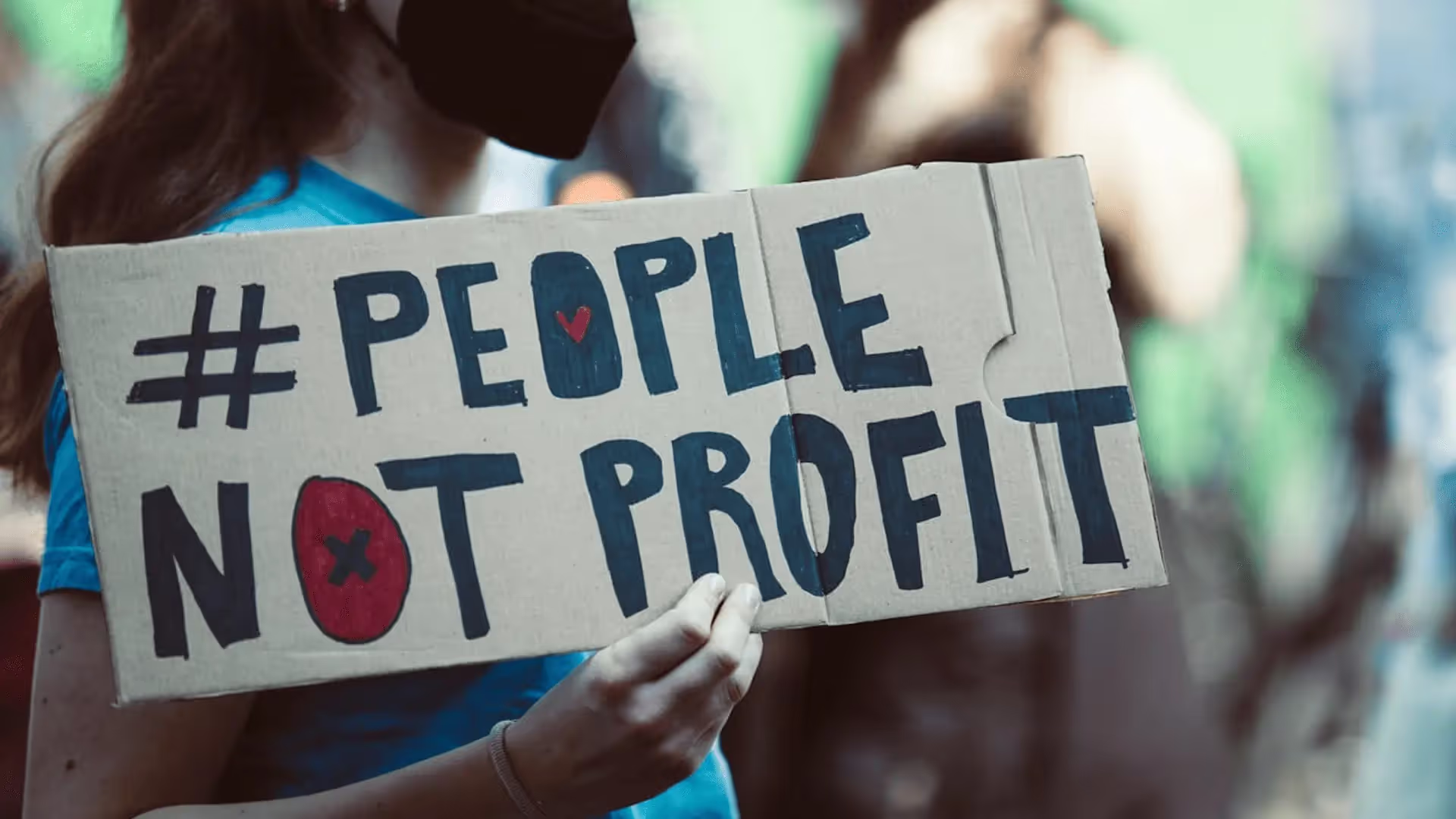
Main Photo by Markus Spiske: https://www.pexels.com/photo/a-person-holding-a-poster-11622796/
References
- Sarkar, C., & Kotler, P. (2018). Brand Activism: From Purpose to Action. Idea Bite Press. Link
- Cammarota, A. et al. (2023). Brand Activism: A Literature Review and Future Research Agenda. International Journal of Consumer Studies. Link
- Journal of the Association for Consumer Research. (2023). Brands and Social Justice Movements: The Effects of True versus Performative Allyship on Brand Evaluation. Vol. 8(1). Link
- ScienceDirect. (2025). The Strength of Stance: The Impact of Brand Activism on Resistance to Negative Information. Link
- DISQO. (2025). 2025 LGBTQ+ Advertising & Marketing Report. Link
- Gravity Research. (2025). 5 Findings That Defined DEI in 2025. Link
- The Drum. (2025). Will Brand Activism Survive 2025? Link
- eMarketer. (2025). Retail's DEI Retreat: Backlash, Betrayal, and the Cost of Silence. Link
- Axios. (2025). US Companies End Pride Sponsorships as Anti-DEI Pressure Mounts. Link
- SLR Consulting. (2026). What the ESG Backlash of 2025 Means for Corporate America in 2026. Link
- Zirrah. (2026).Brands as social agents. Link