Cinema is, among other things, a technology for producing emotional states in strangers. A well-constructed film can make an audience feel grief for a fictional character they have known for ninety minutes, or hope for an outcome in a world that does not exist. The mechanism behind this is not mystery. It is craft: character development, narrative structure, visual language, and the precise management of tension and release.
Brands have always understood, at some level, that they are in the business of producing feelings. What they have been slower to understand is that the craft involved is not fundamentally different from filmmaking. The tools are the same. The standards of execution are the same. And the audience's tolerance for mediocrity is, if anything, lower, because they did not choose to watch.
Why narrative works neurologically
The research on narrative transportation, the psychological state of being immersed in a story, is now substantial enough to be treated as settled science rather than marketing intuition. Narrative transportation theory suggests that when a person becomes immersed in a compelling narrative, they are less likely to challenge its credibility and more likely to trust the brand, retain memory of it, and feel emotionally connected to it. Studies by Green and Brock (2000) and Van Laer et al. (2014) underline that storytelling evokes emotional responses in consumers by transporting them into the narrative, creating a sense of connection with the brand. (ResearchGate, 2024)
The practical implication is significant. Narrative advertising does not persuade through argument. It persuades by changing the emotional state of the viewer, and then associating the brand with that state. This is why a well-made brand film can generate brand preference without making a single factual claim about the product. The claim is implicit, experiential, and considerably more durable than any feature list.
Jennifer Escalas's foundational work on narrative processing in the Journal of Consumer Psychology (2004) established that consumers who engage with brand narratives form stronger self-brand connections: they begin to see the brand as part of their own identity rather than an external product (Escalas, 2004). This is the mechanism behind every enduring brand, from Nike to Patagonia to Apple. They are not selling products. They are offering identity affiliations, and the narrative is the delivery vehicle.
Character as brand architecture
Jennifer Aaker's work on brand personality (1997) established that consumers consistently assign human traits to brands, and that these trait associations predict preference and loyalty (Aaker, 1997, Journal of Marketing Research). The cinema parallel is exact: a brand without a coherent personality is a film without a protagonist. You can follow the plot, but you have no one to care about.
The archetype framework, drawn from Carl Jung and applied to brand strategy by Mark and Pearson in The Hero and the Outlaw (2001), provides a practical tool for this (Mark & Pearson, 2001). Archetypes function as narrative shortcuts: the Hero communicates courage and mastery without requiring explanation; the Explorer communicates freedom and discovery; the Rebel communicates non-conformity. These are not arbitrary classifications. They are patterns of meaning that human beings recognise across cultures, because they appear in the stories cultures have been telling for thousands of years.
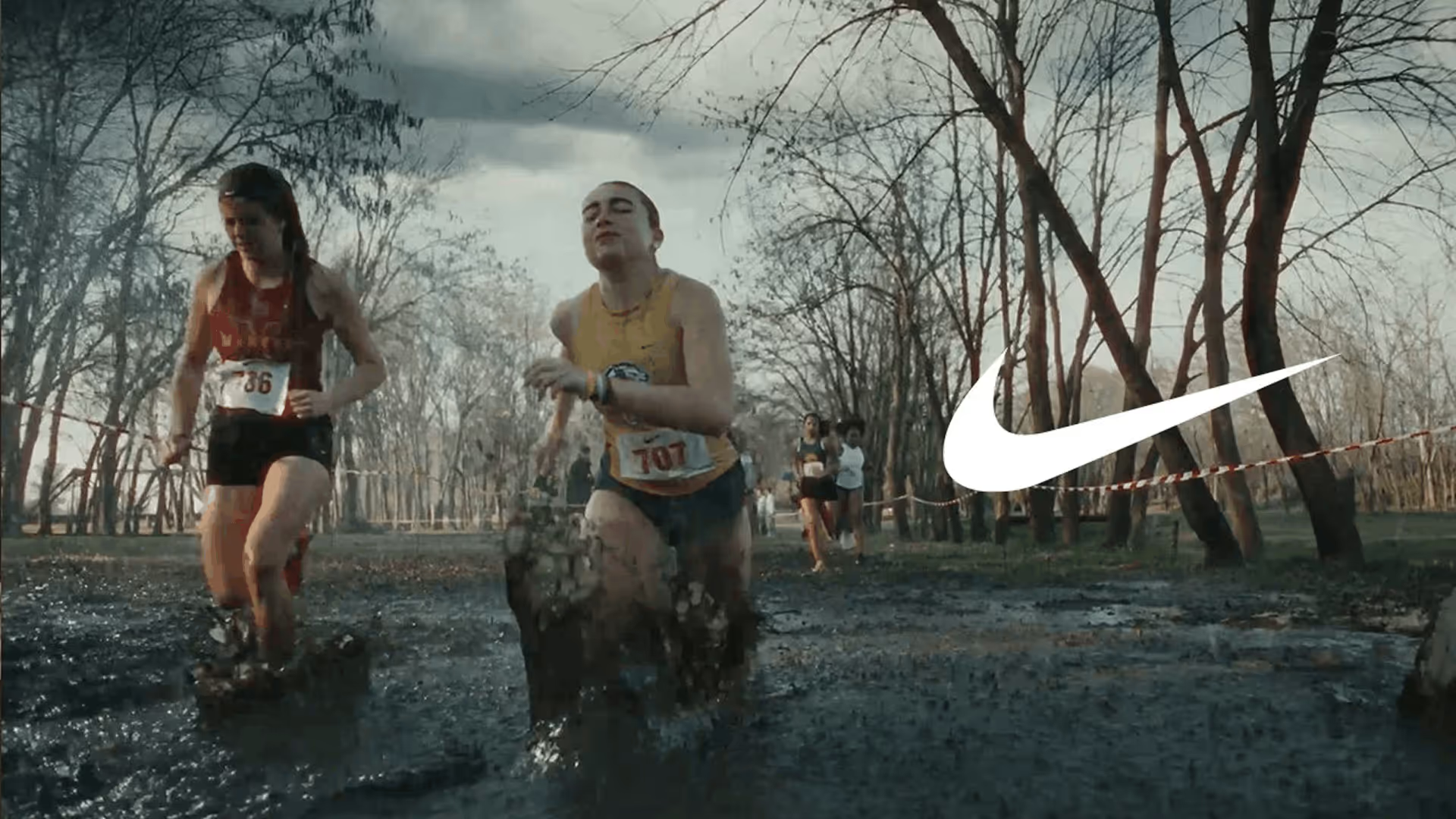
Nike's consistent use of the Hero archetype across five decades of marketing is probably the most studied example, and for good reason: it has remained coherent across entirely different products, cultural moments, campaigns, and celebrity partnerships, because the archetype is stable even when everything around it changes. "Just Do It" is not a slogan. It is a character position.
Structure as emotional strategy
Cinema's three-act structure, setup, conflict, resolution, is not a convention for convenience. It maps onto how human beings process experience and meaning. Brands that build campaigns with this architecture produce fundamentally different emotional outcomes than brands that simply present product information.
The setup establishes the world the brand inhabits and the values it holds. Patagonia does not begin its communication with product features; it begins with an environmental mission that frames everything else. The conflict introduces the tension the brand exists to resolve: Dove's Real Beauty campaign worked not because it sold moisturiser, but because it named a real cultural wound, the gap between how women experienced their own appearance and how advertising told them they should look. The resolution delivers the transformation: Always' #LikeAGirl campaign redefined a phrase, demonstrating that the brand's promise had cultural consequences beyond any individual purchase.
Research published in Psychology & Marketing (2024) confirms that emotional engagement in marketing storytelling operates through both immediate emotional responses and deeper cognitive processing, with the most effective narratives activating both simultaneously. The brands that understand this do not produce content. They produce experiences with emotional architecture.
Visual language as subconscious communication
Henderson, Giese, and Cote's research in the Journal of Marketing (2003) established that visual design activates emotional and cognitive associations independently of any verbal message (Henderson et al., 2003). This is the principle behind Coca-Cola's Christmas campaigns, which have not needed to change significantly in decades because the visual vocabulary, warm reds, glowing whites, family gatherings, snowy landscapes, has accumulated so much seasonal memory that it operates as cultural shorthand.
Apple's use of white space is not an aesthetic preference. It is a claim: that innovation should be uncluttered, that complexity should be resolved into simplicity, that the product exists in a different category from everything around it. Tesla's wide-angle, horizon-line cinematography makes the same argument without words: this brand thinks at a scale that other brands do not reach.
Research published in the Journal of Advertising (2024) found that for an image to stimulate narrative transportation and transport viewers into its world, it must narrate, act, and resonate simultaneously, combining elements that tell a story, convey action or consequence, and connect emotionally with the viewer's own experience. The most effective brand visuals do all three. Most brand visuals do none.
What this requires in practice
Thinking cinematically about branding is not about production budgets or directors. It is about understanding that every brand communication is either transporting the audience somewhere or it is not, and that the difference between the two is craft, not spend.
It requires knowing what archetype the brand embodies and maintaining that coherence across every touchpoint. It requires constructing communication with emotional architecture rather than feature sequences. It requires treating visual language as a primary communication channel rather than decoration applied after the copy is written.
The brands that have done this well over long periods of time have one thing in common: they treat the story as the product, not the wrapper around it. The audience does not remember the claim. They remember how they felt. And they return to the brands that made them feel something worth returning for.
References
- Escalas, J. E. (2004). Narrative Processing: Building Consumer Connections to Brands. Journal of Consumer Psychology, 14(1–2), 168–180. Link
- Aaker, J. L. (1997). Dimensions of Brand Personality. Journal of Marketing Research, 34(3), 347–356. Link
- Campbell, J. (1949). The Hero with a Thousand Faces. Princeton University Press. Link
- Mark, M., & Pearson, C. S. (2001). The Hero and the Outlaw: Building Extraordinary Brands Through the Power of Archetypes. McGraw-Hill. Link
- Henderson, P. W., Giese, J. L., & Cote, J. A. (2003). Impression Management Using Typeface Design. Journal of Marketing, 67(4), 60–72. Link
- Van Laer, T. et al. (2014). The Extended Transportation-Imagery Model: A Meta-Analysis. Journal of Consumer Research, 41(3), 797–817. Link
- Ahmed, S. J. (2024). Crafting Emotional Engagement and Immersive Experiences. Psychology & Marketing, 41, 1514–1529. Link
- Journal of Advertising. (2024). Narrate, Act, and Resonate: How Images Transport Viewers. Link