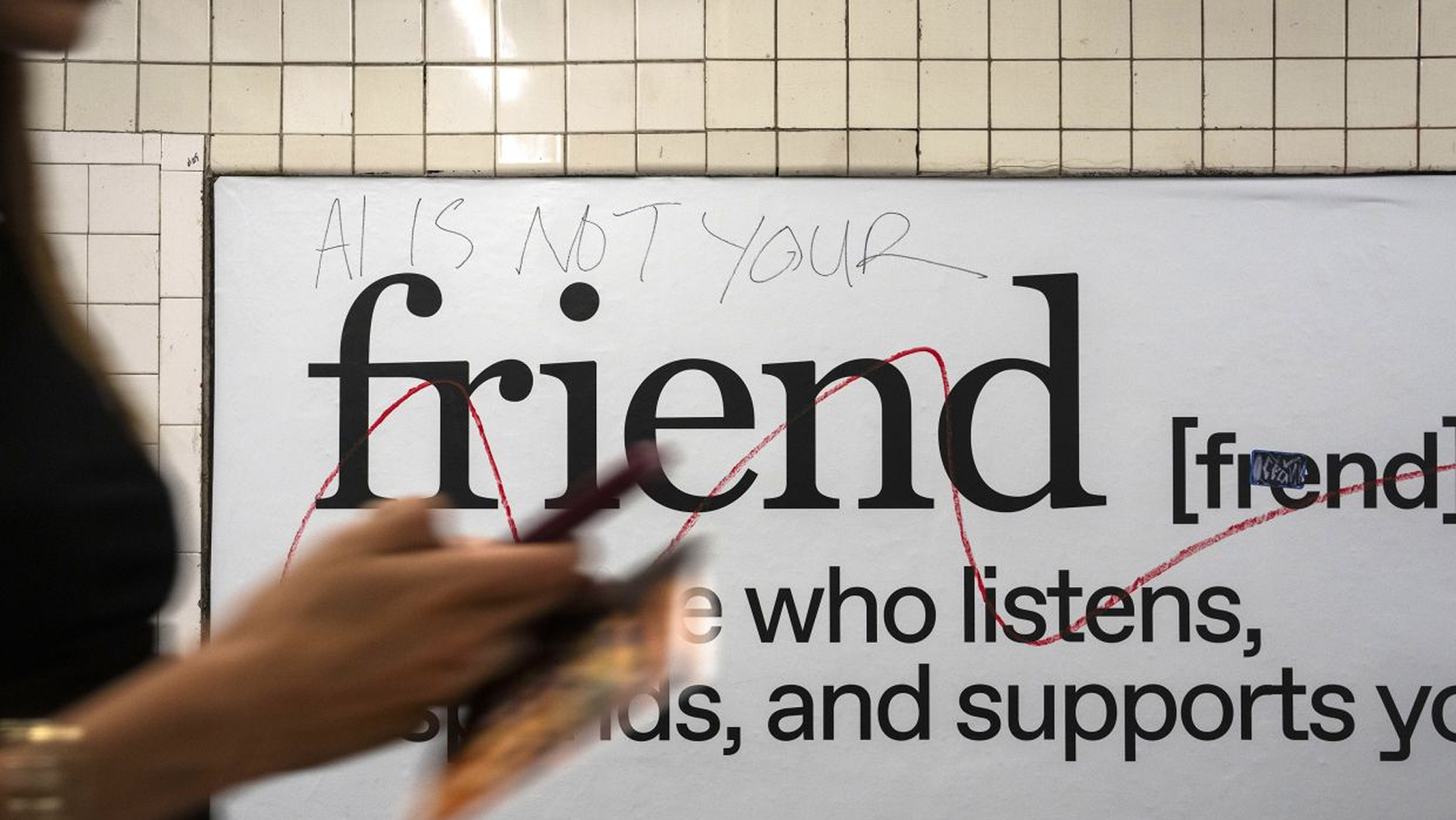
"AI slop" was Merriam-Webster's word of the year for 2025. By 2026, it had moved from online insult to market position. Brands are running campaigns that call out AI content by name. Apple TV added "This show was made by humans" to the end credits of its series Pluribus. Someone built a browser extension called Slop Evader that filters search results to pre-2022 content. In New York's subway stations, ads for an AI wearable called "Friend" have been repeatedly vandalized with messages like "AI is not your friend."
And, well, none of this is a rejection of technology. It is the predictable end of a hype cycle that nobody wanted to slow down.
Every trend collapses the same way
The pattern is consistent enough to be called a cycle. A newcapability emerges, early adopters use it with intention and judgment, and theresults are genuinely interesting. Then the capability scales, the barrierdrops, the volume rises, and the signal that made the early work interestinggets buried under the noise of everyone doing the same thing without the samecare. By the time the backlash arrives, the original promise has been sodiluted that it is hard to remember what anyone found compelling in the firstplace. For me, it's almost a prophecy: launch something, wait for it to becomea trend, and then let it fail.
This happened with content marketing, with brand purpose, influencerpartnerships, storytelling as a strategy. It is happening now with AI. Social feedsare overwhelmed with what audiences call "AI slop": low-effort,repetitive content that looks polished but signals nothing. Inboxes look andread the same regardless of who sent the email. Blog content across competingbrands is structurally indistinguishable. (TheWits Lab, 2026)
In 2025, 20% of consumers said heavy AI use would decreasetheir trust in a favorite brand. In 2026, that figure was 40%, and the sharesaying it would decrease trust significantly was now larger than the entirenegative camp had been a year earlier. (Fractl/ Search Engine Land, via Substack, 2026) The speed of that shift is whatmakes it notable. A doubling in one year is not a slow-moving cultural drift.It is a correction.
The problem is not AI. It is who is using it and why
The honest version of what happened is not that AI failed.It is that AI was handed to people without the judgment to use it well, byorganizations that had no real theory of what they were replacing. Using AIwithout repertoire produces generic output. That is not a flaw in thetechnology. It is a flaw in the assumption that the technology could substitutefor the thing that makes creative and strategic work valuable in the firstplace: a person with enough accumulated knowledge, taste, and context to knowwhat good looks like.
82% of ad executives believe Gen Z and millennials feelpositive about AI ads. Only 45% actually do. That gap widened from 32 points in2024 to 37 points in 2026, meaning the people making the content are gettingmore wrong about their audience over time, not less. (Kompozy, 2026) Thisis the more interesting data point. The brands deploying AI at scale are notjust producing content audiences dislike. They are becoming increasinglydetached from their own audience's actual response. The feedback loop thatwould normally correct a bad creative direction is being bypassed by the speedand volume of AI-enabled production.
What gets lost in the efficiency argument is that speed andjudgment are not the same thing. A team that can produce ten times as muchcontent in the same time has not automatically produced ten times as much goodcontent. More often, it has produced ten times as much content that was neversubjected to the judgment that would have made it worth producing.
The LinkedIn problem and the responsibility transfer
LinkedIn recently introduced a feature allowing users toflag posts as "AI slop." It was framed as giving users more controlover their experience. What it actually does is transfer the moderation burdento the audience while the platform continues to monetize the same content beingflagged.
This is a version of a pattern that appears elsewhere in theAI backlash conversation: organizations deploying labels, toggles, andtransparency features not as genuine accountability mechanisms but as ways toappear responsive while changing nothing structural. The Pinterest toggle todisable AI content in feeds operates similarly. Someone built a browserextension called Slop Evader that filters search results to pre-2022 content,drawing a line between the human past and the synthetic present. (TheState of Brand, 2026) The existence of a third-party tool for something aplatform could address structurally tells you something about where theincentives actually sit.
The label problem also has a precision issue. A piece ofcontent that is 90% AI-generated with no editorial judgment is not the same asa piece of content where AI was used to draft a first version that was thensubstantially rewritten, fact-checked, and shaped by someone who knew what theywere doing. Both can receive the same "AI content" label. Neither theplatforms nor the audiences have developed vocabulary for the distinction,which means the backlash is painting with a brush that is too wide to be useful.
Anti-AI as positioning
In early 2026, Aerie, Equinox, and Almond Breeze rancampaigns that called out AI slop and tech gimmicks by name. Apple TV's seriesPluribus added "This show was made by humans" to its end credits.iHeartMedia launched a "guaranteed human" campaign, promising noAI-generated personalities or music, with research finding 90% of listeners,including people who personally use AI tools, want their media made by realpeople.
The Anthropic case is the most structurally interesting. Acompany that builds AI won the Film Grand Prix at Cannes 2026 with a campaignexplicitly positioned against advertising in AI. "Ads are coming to AI.But not to Claude." The campaign works because it names the tension ratherthan pretending it does not exist, and because the commitment it makes isoperationally real: Claude does not run ads. The positioning is not acommunications decision layered over a different reality. It is a communicationsdecision that describes the actual product.
This is the distinction that separates anti-AI positioningthat will hold from anti-AI positioning that will collapse. The brands thatthrive in 2026 treat AI as infrastructure rather than innovation. They use itto work faster, test more, personalize at scale, and optimize performance. Andthey do not announce it. (Breef,2026) The brands losing are the ones that picked a visible side and madethe technology itself the story.
What the backlash is actually asking for
Audiences are not asking brands to stop using AI. They arenot anti-technology. They are anti-blandness. They want voice, opinion,specificity, and visible human effort — the exact qualities AI defaults awayfrom. (Nurdd,2026)
That is a solvable problem, but not by switching the tooloff. It is solved by putting the tool in the hands of people who have enoughrepertoire to know what to ask of it, enough taste to recognize when the outputis generic, and enough judgment to know which parts of the work require a humanand which parts do not.
The Coca-Cola AI Christmas ad was not rejected because itwas made by AI. It was rejected because it was made without the institutionalknowledge of what that specific ad had meant to people for decades. Thetechnology could have produced something adequate. What it could not producewas the understanding that adequacy was exactly the wrong standard to apply.
That understanding lives in people. Replacing the people tokeep the tool is not efficiency. It is the removal of the thing that made theoutput worth producing.
Photo: Hiroko Masuike/The New York Times
References
- Fractl / Search Engine Land / Substack. (2026). Stop the Slop: What the Backlash Against AI Content Means for Your Small Business. Link
- Kompozy. (2026). The AI Marketing Backlash: Why "AI-First" Brands Are Falling Flat. Link
- The Wits Lab. (2026). The AI Content Flood of 2026: Why Brands Are Running Back to Authentic Human Voices. Link
- Breef. (2026). The AI Marketing Backlash: Why "AI-First" Brands Are Starting to Fall Flat. Link
- The State of Brand. (2026). The Anti-AI Brand Is Becoming a Real Market Position. Link
- Nurdd. (2026). Made by Humans: How Brands Are Beating AI Slop with Authentic Content in 2026. Link
- Mojo Creative Digital. (2026). The Anti-AI Backlash Is Real: How Smart Brands Use AI Without Showing It. Link