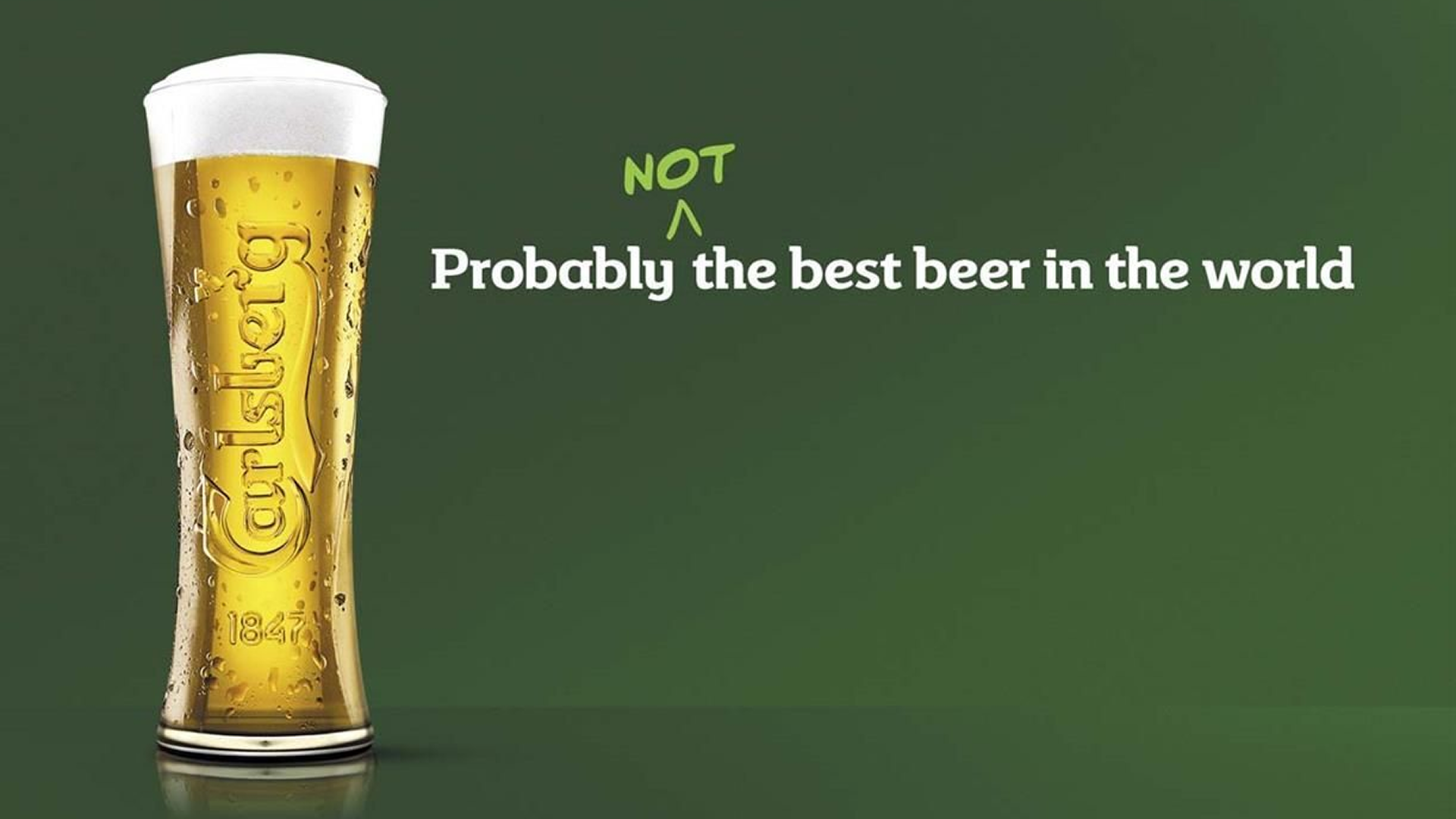
In 2024, Carlsberg ran a campaign with the tagline "Probably not the best beer in the world." In 2025, Dove published unedited Reddit reviews of its new hair mask, including one that described the smell as "an old lady wearing too much intense perfume." In 2026, luggage brand Béis launched a summer campaign where founder Shay Mitchell dressed as a surgeon and marked up the brand's hero bag as if it were a plastic surgery patient, reading customer complaints aloud from Instagram.
None of these are accidents. All of them are strategy.
The mechanism behind the joke
A 2024 study published in Psychology & Marketing examined how consumers respond to self-deprecating advertising across six experiments. The findings are precise: when a brand criticizes an attribute that consumers consider less important to their purchase decision, self-deprecating ads significantly outperform self-promoting ones on brand trust. Self-deprecation elevates the brand's social attractiveness, which reduces consumer skepticism. As a secondary effect, it also lowers advertising avoidance, meaning people are less likely to skip or ignore the content (Kale et al., Psychology & Marketing, 2024).
The study rules out several intuitive alternative explanations. The effect is not driven by novelty, consumer engagement, or the content feeling nonconformist. It works because a brand that acknowledges its own flaws reads as more socially intelligent, and social intelligence reduces the skepticism that advertising has been accumulating for decades.
A parallel paper published in AMS Review in 2025 formalizes a taxonomy of what the researchers call Brand Communications with Self-Directed Negative Messages (BCSNMs), identifying three distinct types: self-deprecation, humblebragging, and two-sided messaging. The paper notes that the strategy is counterintuitive by design: traditional advertising theory holds that brands should emphasize positive attributes. The research suggests this assumption is increasingly wrong, particularly in high-skepticism environments (AMS Review, 2025).
The condition that makes it work
The research is consistent on one point: self-deprecation only functions as a trust-building mechanism when the flaw being acknowledged is something the brand can actually address, or something that does not undermine the core value proposition.
Béis can joke about the Weekender bag being hard to carry because it can redesign the Weekender bag. More importantly, the critique does not touch the product's central promise: it is still well-made, still functional, still worth buying. The surgery metaphor works because it frames the redesign as care, not failure.
The distinction matters. A brand that self-deprecates about surface-level attributes reads as self-aware. A brand that jokes about a safety failure, an ethical breach, or a systemic problem reads as dismissive. Ellie Bamford, chief strategy officer at VML, puts it clearly: "You're not going to choose to make light of a really deep moral or ethical failure on behalf of the brand. You're going to lean into something that you can actually resolve to the consumer's advantage" (Business of Fashion, 2026).
Ryanair is the most sustained example of this logic in practice. The airline has built an entire social media identity around the things people hate about flying with it: the fees, the seats, the carry-on restrictions. None of the jokes touch safety, reliability, or on-time performance. The self-deprecation is contained to attributes that are either unavoidable given the low-cost model or that the audience has already priced into their expectations. Within that perimeter, the humor is relentless. The result is a brand that is genuinely liked by people who are simultaneously complaining about it, which only works because the jokes are honest.
Why this works specifically now
Research from Morning Consult indicates that 76% of Gen Z consumers prefer brands that acknowledge their flaws over those projecting perfection, compared to 43% of Baby Boomers. Branded content featuring self-deprecating humor generates 38% higher engagement among users under 25 (Gopinath, Publicis Media, 2025).
The gap between generations reflects something more than taste. Gen Z grew up in an environment saturated with advertising and commentary on advertising, influencer culture alongside commentary on influencer culture, brand activism alongside commentary on brand activism. The meta-awareness is the baseline. A brand that operates without acknowledging it reads as naive at best. A brand that operates within it reads as a peer.
The Dove Reddit campaign illustrates this at an operational level. The brand did not simply publish negative reviews as a stunt. It published them on Reddit, inside a conversation about the product that was already happening organically. The decision was not to manufacture authenticity but to amplify what already existed, while being careful not to appear to curate or shape the conversation. As Emily Barfoot, head of hair and skin for Dove US, put it: "If you try to shape and curate the conversation, they know."
There is also a functional benefit: because Reddit is a primary source for AI-generated search responses, brand presence in authentic Reddit conversations increases citation frequency in AI search results, an effect the Dove team explicitly tracked.
The boundary condition nobody talks about
A 2025 study in Psychology & Marketing on brand disparagement humor identifies a consistent finding across the literature: the strategy works, but only when it aligns with how consumers already perceive the brand. When self-deprecating humor is inconsistent with existing brand personality, it produces negative outcomes (Iveson et al., Psychology & Marketing, 2025).
The brands that execute self-deprecation well, Ryanair, Wendy's, Béis, Dove, share a pre-existing personality that is either casual, direct, or anti-corporate. The humor extends something already present in the brand's voice rather than adding something foreign to it. A luxury brand attempting the same strategy would face a different reception, not because luxury consumers are humorless, but because the incongruity between category codes and social codes would read as dissonant. Data supports this: brands whose self-deprecating content aligns with known customer pain points generate 3.8 times more positive sentiment than those adopting the approach as a trend.
Self-deprecation is a positioning decision. The brands that benefit from it are the ones for whom honesty and directness were already part of the deal.
References
- Kale, S. et al. (2024). Impressive Insults: How Do Consumers Respond to Self-Deprecating Advertisements? Psychology & Marketing. Link
- Iveson, A. et al. (2025). We're Not Better, We're Just Different: How Brand-Customer Disparagement Humor Helps to Build Brand Communities. Psychology & Marketing. Link
- AMS Review. (2025). Brand Communications with Self-Directed Negative Messages: A Conceptual Framework and Research Agenda. Link
- Journal of Theoretical and Applied Electronic Commerce Research. (2025). Turning Setbacks into Smiles: Exploring the Role of Self-Mocking Strategies in Consumers' Recovery Satisfaction After E-Commerce Service Failures. Link
- Business of Fashion. (2026). Why Some Brands Are Roasting Themselves. Link
- Gopinath, R. / Publicis Media. (2025). The Rise of Brand Roasting and Self-Deprecation. Link