Marketing has a youth problem. Not because young people don't matter, but because the industry's fixation on them has become a kind of wilful blindness, one that conveniently ignores the largest wealth transfer in modern history and a consumer demographic that, by most projections, will define the next decade of global spending.
Older consumers are not a niche. They are, increasingly, the market.
The invisibility problem
People over 50 control roughly 70% of disposable income in the United States alone, and the pattern holds across most high-income economies. Yet a study by AARP found that only 5% of advertising spend targets this group, and when older adults do appear in campaigns, they tend to arrive as props: the wise grandparent, the grateful retiree, the person inexplicably baffled by a smartphone (AARP, 2019).
It is a strange creative failure. The audience is there, the money is there, the cultural relevance is there, and brands still look the other way.
This is not just an equity conversation, though it is that too. It is a strategic one. Brands that default to youth-first marketing are not being edgy or forward-thinking. They are leaving the table early.
What the data actually says
The 50+ segment is not a monolith of decline. Research from Nielsen consistently shows this group is digitally active, brand-curious, and significantly more loyal than younger cohorts when they feel seen. They travel more than millennials. They over-index on premium categories. They are not waiting for brands to reach them; they are simply noticing which ones bother (Nielsen, 2021).
The real problem is not that older consumers are hard to reach. It is that most brand teams are too young, too trend-focused, or too attached to aspirational youth codes to even try. As Becca Levy's research on age stereotyping has shown, the devaluation of older adults is not incidental: it is structurally reproduced, including through media and advertising (Levy, 2009).
From representation to strategy
Being age-inclusive is not about adding a silver-haired model to a campaign and calling it diversity. That is optics, not strategy.
Real inclusion means designing products and experiences that work across a wider range of bodies, abilities, and life contexts, without making "accessibility" the headline. It means speaking with this audience, not about them. It means understanding that a 58-year-old today has a completely different cultural reference frame, financial profile, and set of expectations than a 58-year-old in 2003, and that gap will keep widening.
AARP's Disrupt Aging framework is worth reading here: it challenges brands to move from patronising narratives of limitation towards ones that reflect the actual texture of life after 50, which tends to involve more autonomy, more disposable time, and considerably more discernment than most campaigns credit (AARP Disrupt Aging).
The creative case
There is also a craft argument. Campaigns that engage older consumers honestly tend to be more interesting. They require nuance. They resist the easy shorthand of youth culture. They demand actual storytelling.
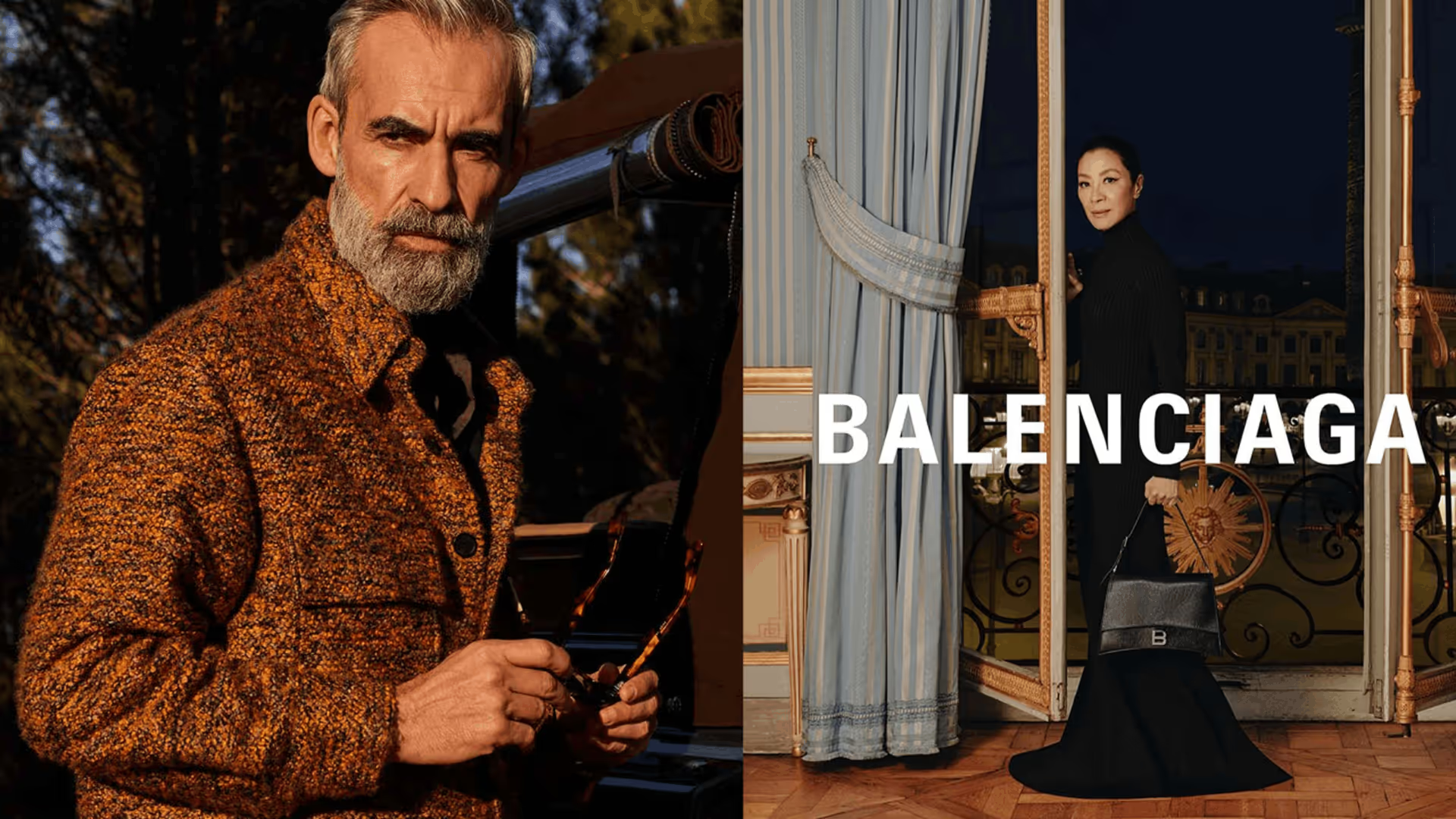
Some of the most culturally resonant brand work of the last decade has featured older talent precisely because it breaks the visual monotony of age-homogeneous advertising. Céline's casting of Joan Didion, then in her eighties, was not an accessibility statement. It was an aesthetic one, and it landed because it was specific, not because it was inclusive in a generic sense (The Cut, 2015).
That is the difference. Inclusion as strategy produces checklists. Inclusion as creative vision produces work that actually connects.
Brands that ignore older consumers are not being bold. They are being careless, with their creative ambition and their commercial logic. The demographic shift is not coming. It is already here. The brands building real equity right now are the ones that understand age-inclusive is not a modifier. It is a baseline.
References
- AARP. (2019). Older Adults and the Economy: Consumer Spending and Financial Resilience. AARP Research. Link
- Levy, B. R. (2009). Stereotype Embodiment: A Psychosocial Approach to Aging. Current Directions in Psychological Science. Link
- Nielsen. (2021). From Gen Z to the Silent Generation: Media Habits of US Adults. Nielsen Insights. Link
- AARP. (n.d.). Disrupt Aging. AARP. Link
- The Cut. (2015). Céline Cast Joan Didion in Its New Ad Campaign. New York Media. Link